It’s often said that only one person dies from a bear attack each year in the U.S. But that number doesn’t tell the whole story. Between 2020 and 2022 alone, at least eight people were killed by bears.
Still, those numbers are tiny compared to deaths from dogs, snakes, or even spiders. So while bear attacks are rare, the real danger isn’t to people—it’s to the bears themselves.
In Montana’s Northern Continental Divide Ecosystem—home to over a thousand grizzlies—a study found that just one in ten adult bears die of old age. Humans account for a staggering 71% of adult grizzly deaths, and many of those happen only after a bear learns to associate people with food. Once that happens, it’s often too late.
As the saying goes, a fed bear is a dead bear.
Presented by Blue Coolers

Why Bear-Resistant Coolers Matter
Most human–bear conflicts start with something simple: a cooler left out overnight, an open garbage can, or snacks left in a tent.
Once a bear gets rewarded with food from a human source, even once, it remembers. And that creates a dangerous situation for everyone involved.
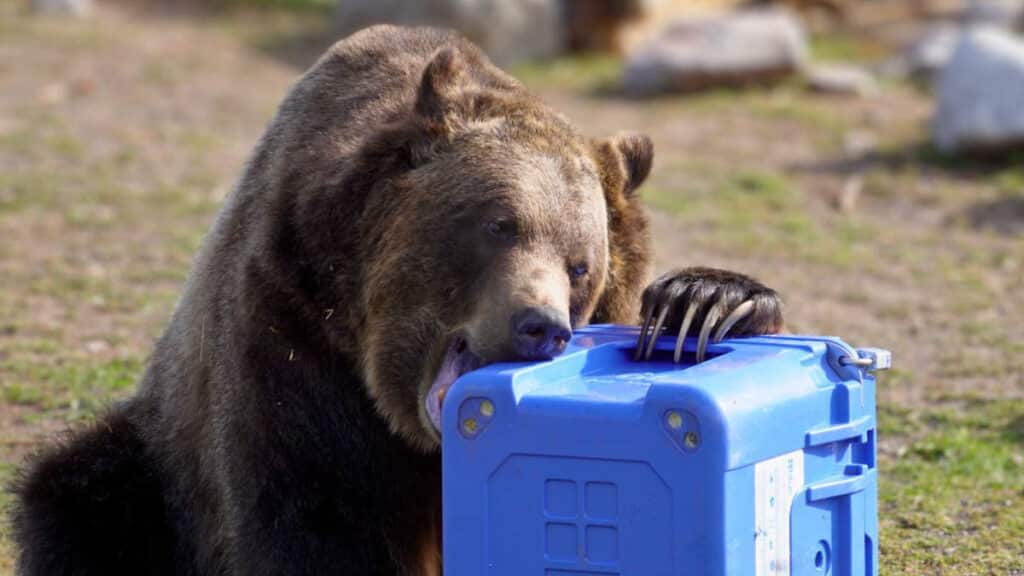
Wildlife managers call this food conditioning, and it’s one of the leading causes of bear deaths in North America. When bears repeatedly raid campsites or garbage bins, they’re often euthanized for public safety.
The good news? We can prevent most of these encounters by simply securing our food and trash. And that’s where the Interagency Grizzly Bear Committee (IGBC) comes in.
What Is the IGBC and What Do They Do?
The Interagency Grizzly Bear Committee is a collaboration between the U.S. Forest Service, National Park Service, U.S. Fish and Wildlife Service, and several state wildlife agencies.
Among their responsibilities is managing the Bear-Resistant Products Testing Program, which evaluates everything from coolers to garbage cans and storage lockers. Their goal: identify and certify products that can stand up to the strength and persistence of a determined grizzly.
Inside the Bear Testing Process
Bear testing isn’t done in a lab—it’s done with real grizzly bears.
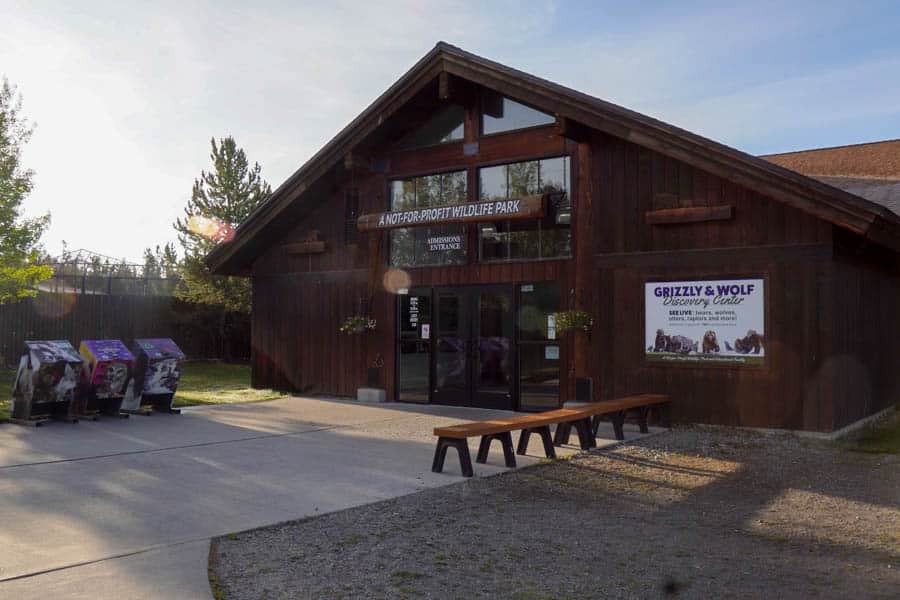
I visited the Grizzly and Wolf Discovery Center in West Yellowstone, Montana, where IGBC testing happens year-round, but mostly in late Spring through early Fall. There, I met Chris Wiese, who coordinates product testing at the center.
“Our bears play a huge role in conservation,” Chris told me. “They’re ambassadors. If they can’t break into a container, we’re confident that wild bears won’t either.”
The process is surprisingly hands-on—and a little messy. And it doesn’t just apply to coolers, but other containers too, like bear canisters for backpacking, garbage cans, and even dumpsters for people’s homes and businesses in bear country.
Before a test, Chris removes any small parts that could hurt the bears, then fills the cooler with irresistible bait. The idea is to give the bears a reason to try their hardest to break into the cooler.
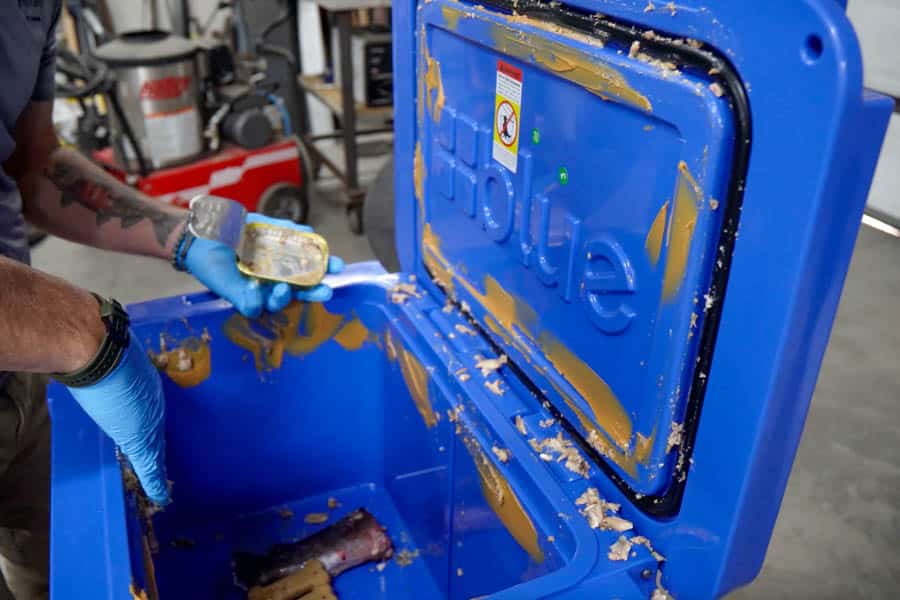
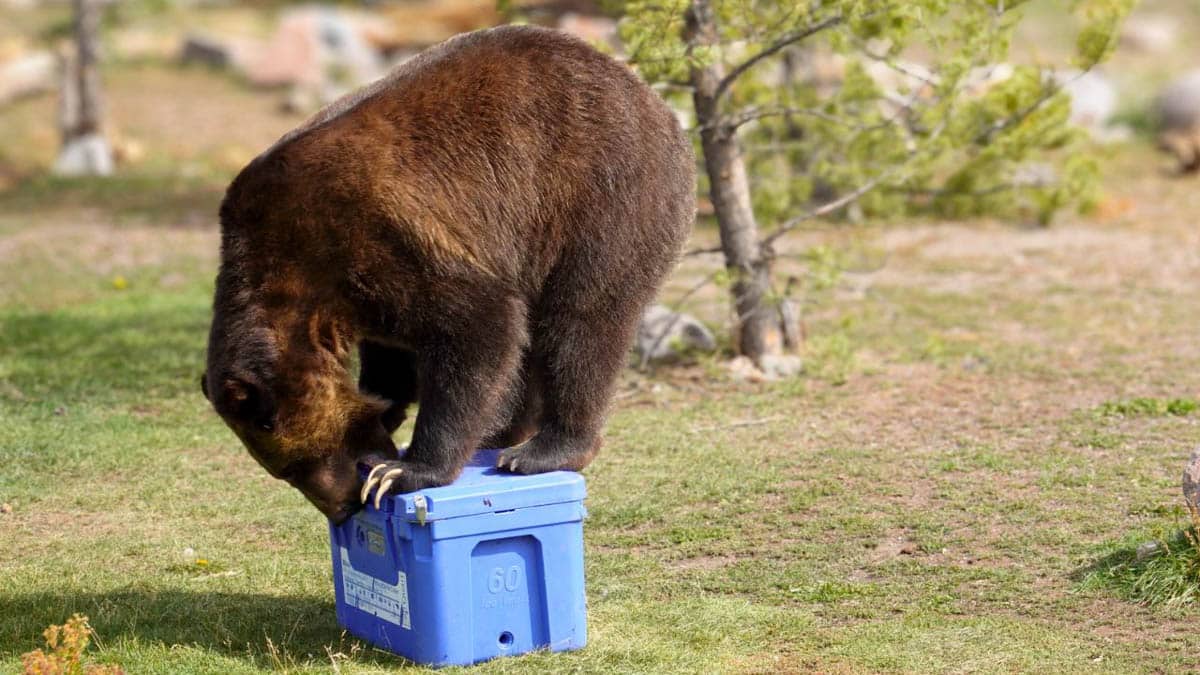
Then, the coolers go into a secure enclosure, where one or two bears are released at a time to “test” it.
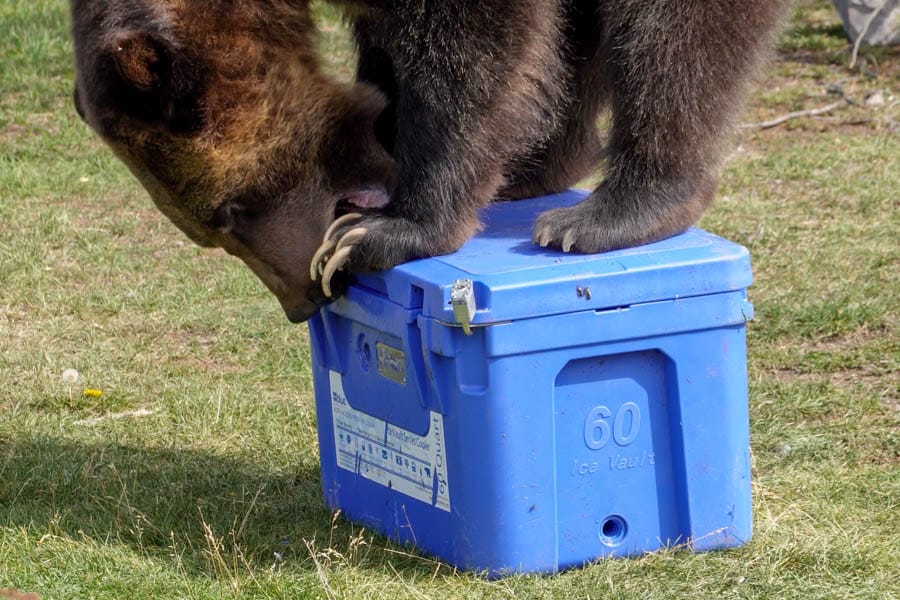
To pass certification, the container must withstand at least 60 minutes of active bear contact—chewing, clawing, pawing, jumping, and rolling—without the bear getting inside.
Bear-Resistant vs. Bear-Proof
There’s really no such thing as a bear-proof cooler. Given enough time and determination, a grizzly could probably break into just about anything. The goal isn’t to create an impenetrable box—it’s to build one tough enough to survive as long as a bear’s attention span.
That’s why the IGBC standard requires 60 minutes of continuous bear contact—paws, claws, or jaws on the product. Only one container is tested at a time and sometimes it takes multiple sessions over days, weeks, or even months to complete the test.
Chris films every test and reviews the footage back in his office, timing exactly how long the bears were actively working on the cooler.
The reasoning behind this is simple: if a captive bear that knows food is inside, and has years of practice breaking into containers, can’t get in after a full hour of trying, it’s extremely unlikely that a wild bear—encountering a cooler for the first time—will succeed. In the wild, a bear might sniff, paw, or push the cooler for a bit, but if it doesn’t yield quickly, it’ll usually move on to easier food.
The bears at the Grizzly and Wolf Discovery Center are incredibly skilled. Chris has seen one reach through a dumpster slot to flip a latch, and I personally watched Coram, their largest bear, unscrew a drain plug like a human.
These bears are professionals—breaking into containers is their job. So if they can’t do it in an hour, your average wild bear probably won’t even try that long.
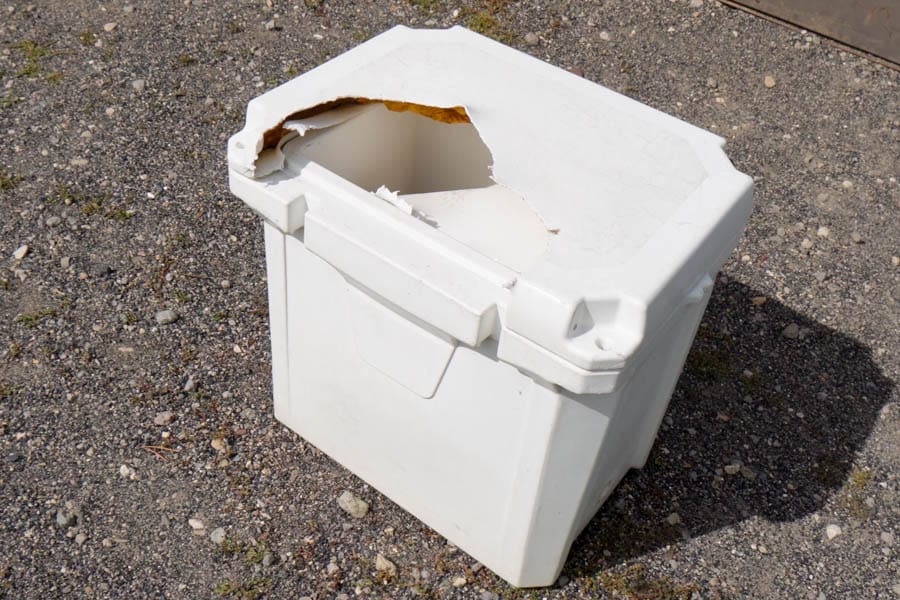
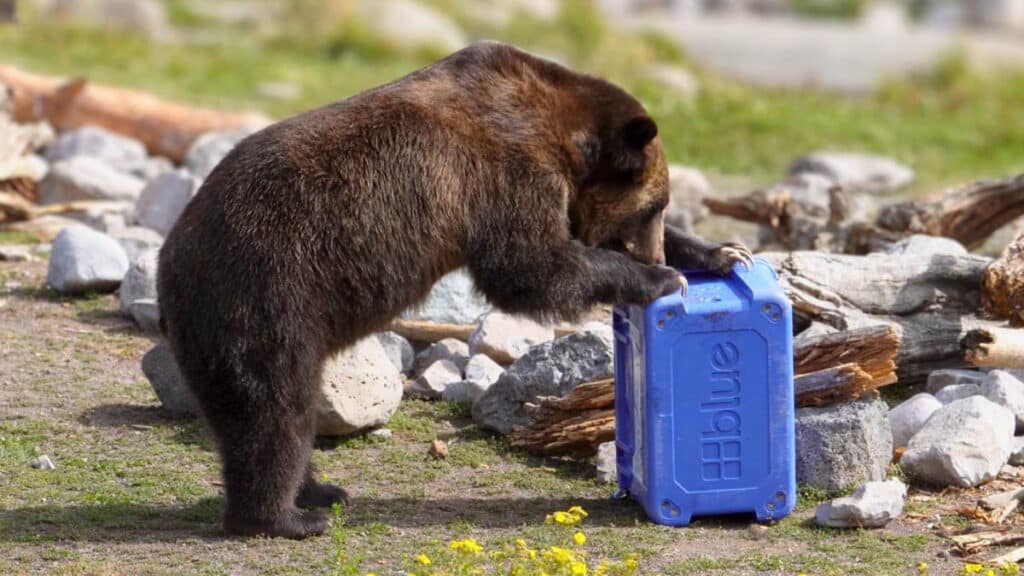
Chris says the most common failure point isn’t the latch or hinge—it’s the lid or sidewall. The bears often use what he calls the “CPR method,” standing on a container and pressing down hard with both front legs. If the plastic flexes or cracks, it’s game over. Other times, they’ll start a small puncture with their teeth, then bite and pry until they tear their way through the insulation.
In fact, a cooler can fail the test with just a hole larger than a quarter. That’s all it takes to prove the container isn’t bear-resistant enough for certification.
Padlocks Matter
IGBC certification assumes the cooler is padlocked, because latches are for people—bears can rip them off in seconds.
“Bears are like toddlers,” Chris said. “If they can put something in their mouth, they will.”
That’s why Chris removes all latches, rubber feet, or any loose plastic parts (except drain plugs) during the test in order to prevent bears from ingesting something that might harm them.
Then, all coolers or containers are tested with padlocks on and locked tight.
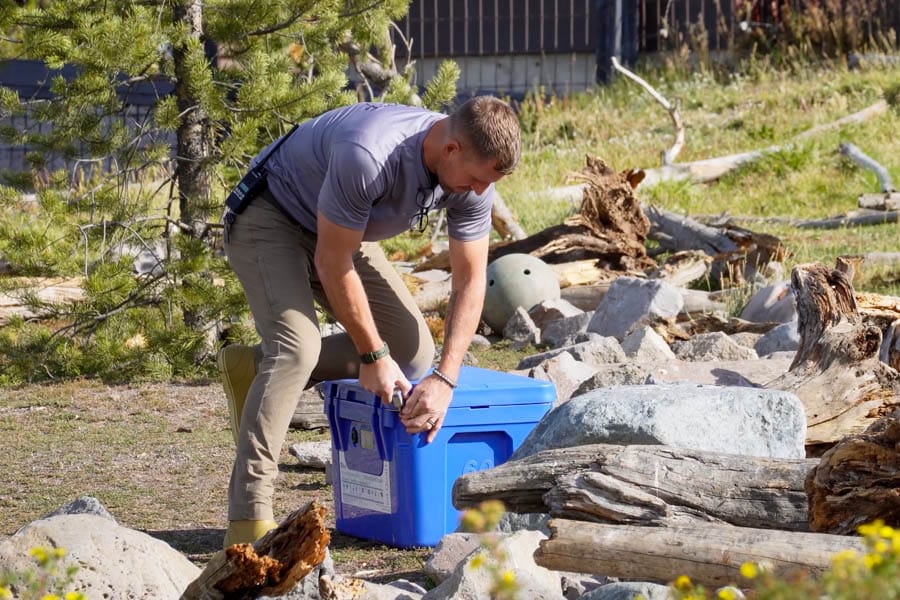
“You want a tight shank,” Chris explained. “If the lid can lift more than a quarter-inch, the bear’s gonna get in there.”
That was news to me. I’ve taken IGBC-certified bear-resistant coolers camping in bear country before, and I’ve even locked them up. But now I know the padlocks I used were too long.
Use a short-shank padlock, as short as you can fit on your cooler, so the lid can’t lift more than a quarter of an inch. Longer shanks create a gap that gives a bear leverage to pry it open and voids the “bear-resistant” benefit.
A Rare Look Behind the Scenes
Watching a full-grown grizzly work on a cooler is both thrilling and humbling. They’re curious, smart, and ridiculously strong. It’s also easy to see why this testing matters.
Every cooler or container that passes this process earns the official IGBC Bear-Resistant Certification—a small sticker or engraving that means it’s been put to the ultimate test.
So next time you shop for a cooler, look for that IGBC label. It’s more than a badge of toughness—it’s a mark of responsibility.
From the Manufacturer’s Perspective
This particular test was sponsored by Blue Coolers, whose products were in the ring (or the enclosure, rather).
I spoke with Marcus Sorensen, Blue Coolers’ CEO, about why the company decided to go through the process.
“For us, it’s about building trust,” Marcus said. “Some customers require certification, but we also believe in making products people can actually rely on in bear country. And honestly, it’s the right thing to do.”
He admitted it’s a nerve-wracking process. “You don’t know for sure if it’ll pass until the test is done,” he laughed. “If it doesn’t, you’re back to redesigning molds—and that’s not cheap.”
Thankfully, Blue Coolers passed with flying colors.
Marcus also emphasized the brand’s focus on sustainability. “We’re working on cooler lines made with ocean-bound plastics. We want to make long-lasting products that people keep for years—not stuff that ends up in landfills.”
Why It Matters for Everyone Who Camps
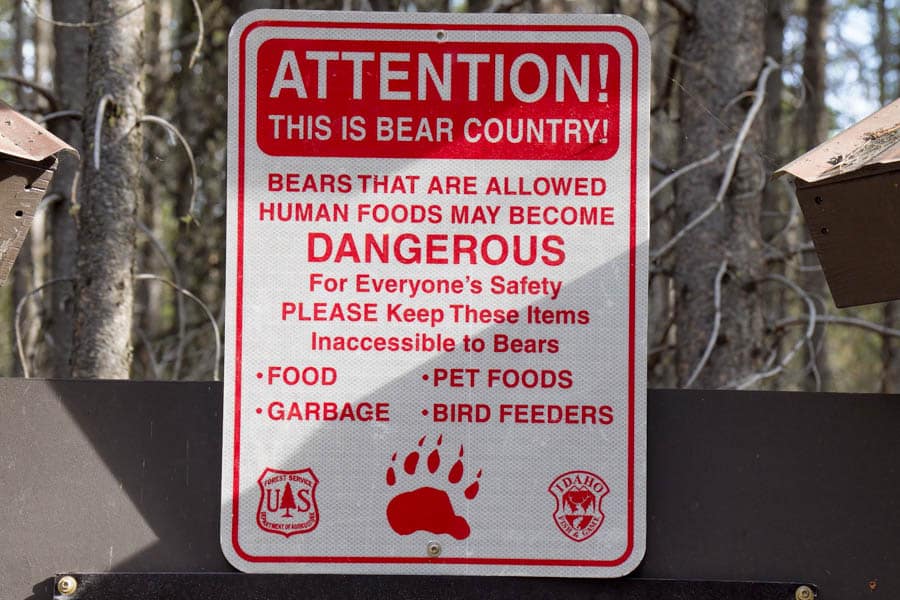
If you camp, fish, hunt, or live anywhere near bear country, the takeaway is simple: secure your food.
When you use a bear-resistant cooler, storage locker, or trash can, you’re not just protecting your stuff—you’re helping keep bears wild.
Grizzly bears, in particular, have been protected under the Endangered Species Act for 50 years. It’s a shame to cause them to be needlessly euthanized because we campers are too cheap or too lazy to lock up our food in a safe cooler when spending the night in their home.
As Chris put it:
“It’s all about keeping bears wild. We don’t want them taken out of the population or food conditioned to human areas.”
Final Thoughts
Watching a grizzly try to crack open a Blue Cooler was one of the most fascinating things I’ve ever filmed. It’s raw, real, and surprisingly hopeful.
Brands like Blue Coolers that invest in IGBC certification are doing more than proving durability—they’re helping conserve wildlife by preventing conflicts before they happen.
Then, it’s up to us to lock our coolers up tight, with a properly sized padlock, any time we are not actively using them in bear country.
If you want to learn more about IGBC testing or visit the bears yourself, check out:
- Interagency Grizzly Bear Committee – Bear-Resistant Products Program
- Grizzly & Wolf Discovery Center, West Yellowstone, MT
- Blue Coolers
Because choosing IGBC-certified gear isn’t just smart—it’s part of keeping wild places and animals wild.